Nuclear Fusion
I am the co-lead of the Plasma Physics and Diagnostics group within A*STAR’s Future Energy Acceleration and Translation (FEAT) programme. My work focuses on modelling the physics that underpins magnetic-confinement fusion (MCF) systems.
Magnetic-confinement fusion aims to sustain a plasma hot enough for fusion reactions by using strong magnetic fields to trap charged particles. Tokamaks and stellarators are the leading designs, but both face the same core challenge: maintaining good confinement while safely exhausting heat and particles. Much of this is controlled by the plasma edge — the complex region where hot core plasma transitions to cooler boundary plasma, interacts with neutrals, and impacts material surfaces.
Within this context, my research spans three connected areas:
- Edge plasma physics: Understanding turbulence, parallel transport, recombination, and plasma–neutral interactions in the scrape-off layer and divertor, where most of the exhaust power flows.
- Plasma–material interactions: Modelling sputtering, tungsten erosion, impurity migration, liquid-metal protection schemes, and the multi-scale coupling between the surface response and the edge plasma.
- Diagnostics enhanced by machine learning: Developing data-driven methods that combine synthetic diagnostics, simulation output, and experimental measurements to reconstruct plasma structure and extract physical parameters with higher fidelity.
Together, these efforts aim to improve predictive understanding of the plasma edge and the divertor region — key bottlenecks for next-generation fusion reactors such as ITER, DEMO, and STEP.
Astrophysics
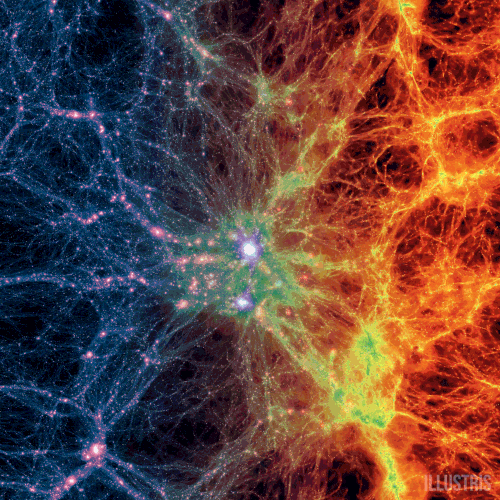
Before transitioning into fusion research, I worked in computational astrophysics, focusing on large cosmological simulations of galaxy formation. My work examined how baryons (the ordinary matter we are made of and can observe) interact with and influence the evolution of dark matter structures in the Universe.
This involved:
- Running and analysing high-resolution cosmological simulations
- Studying baryon–dark matter coupling, feedback processes, and multi-scale structure formation
- Developing and applying numerical methods for high-performance computing environments
Although astrophysical and fusion plasmas operate in different regimes, the underlying physics—fluid dynamics, transport, instabilities, and multi-scale behaviour—provides a strong foundation for modelling complex systems. This background continues to shape my approach to fusion research, especially in high-fidelity simulation and data-intensive workflows.
Data Science
Alongside physics-based modelling, I work extensively with data analysis, machine learning, and scientific visualisation. Fusion simulations and diagnostics generate vast, high-dimensional datasets, and modern data-science tools are essential for interpreting plasma behaviour, benchmarking models against experiments, and communicating results clearly.